
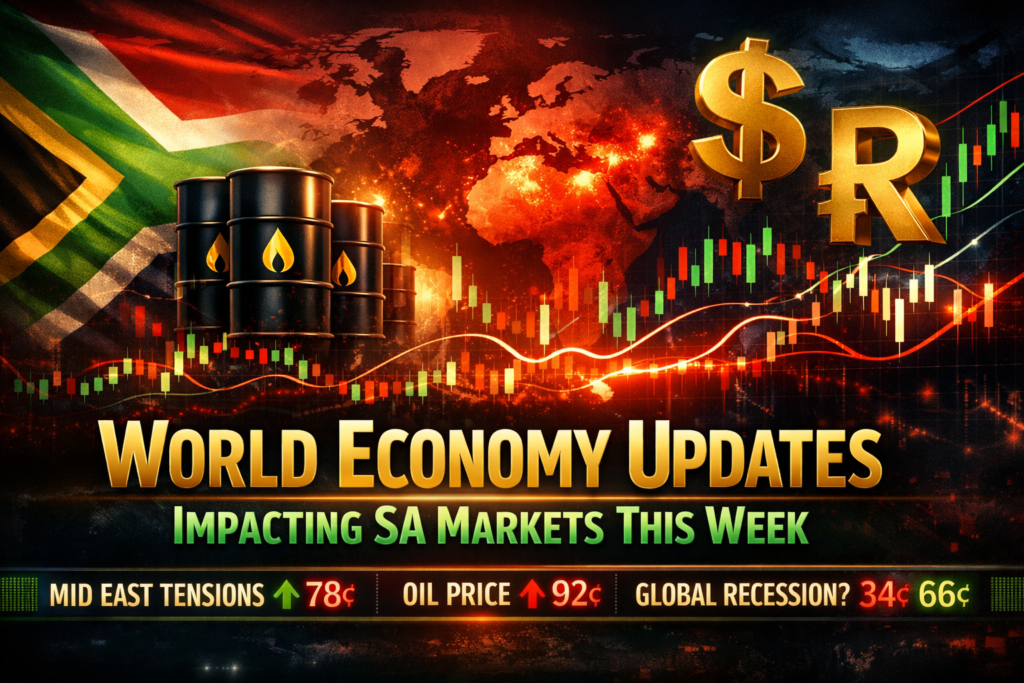
South African investors, exporters and everyday citizens are closely watching World Economy Updates this week as global shocks ripple straight into our local markets. From surging oil prices caused by Middle East tensions to the US Federal Reserve’s latest stance and ongoing tariff uncertainties, these World Economy Updates are moving the rand, JSE and inflation outlook in real time.
At polymarketsa.com we bring you the sharpest analysis of how World Economy Updates are hitting South Africa — and how live prediction markets on Polymarket.co.za give you an unbeatable edge to anticipate and even profit from the volatility.
Why World Economy Updates Matter Deeply to South African Markets Right Now
This week’s World Economy Updates come at a sensitive time for South Africa. Our economy posted modest 1.1% growth in 2025, with Q4 2025 showing only 0.4% quarter-on-quarter expansion. While domestic reforms and lower inflation (down to 3.0% in February) offer some breathing room, external forces dominate the narrative.
Key World Economy Updates this week include:
- Escalating Middle East conflict driving Brent crude above $100–$116 per barrel at peaks, with fears of prolonged disruption through the Strait of Hormuz.
- The US Federal Reserve holding rates steady, reinforcing a cautious global monetary environment.
- Ongoing Trump administration tariff pressures, including Section 301 investigations that could hit South African exports.
- OECD’s upcoming Interim Economic Outlook (released 26 March 2026) and broader IMF projections showing global growth around 3.3% for 2026 amid divergent forces.
These World Economy Updates directly influence the rand-dollar exchange rate, bond yields, equity prices on the JSE and the cost of living for millions of South Africans.
Middle East Tensions and Soaring Oil Prices – A Major World Economy Update for SA
One of the most dramatic World Economy Updates this week is the sharp rise in oil prices triggered by conflict in the Middle East. Brent crude has spiked, threatening South Africa as a net oil importer. Higher fuel costs feed directly into transport, food prices and overall inflation — potentially forcing the South African Reserve Bank (SARB) to keep rates unchanged or even hike later in 2026.
Business leaders have warned that sustained high oil prices could derail South Africa’s fragile 2026 recovery. With petrol prices already under pressure, this World Economy Update hits households hard at the pump and businesses through higher logistics costs. Prediction markets are pricing in elevated volatility around energy commodities, giving traders a clear signal on potential rand weakness.
US Fed Decision and Global Interest Rate Outlook – Critical World Economy Updates
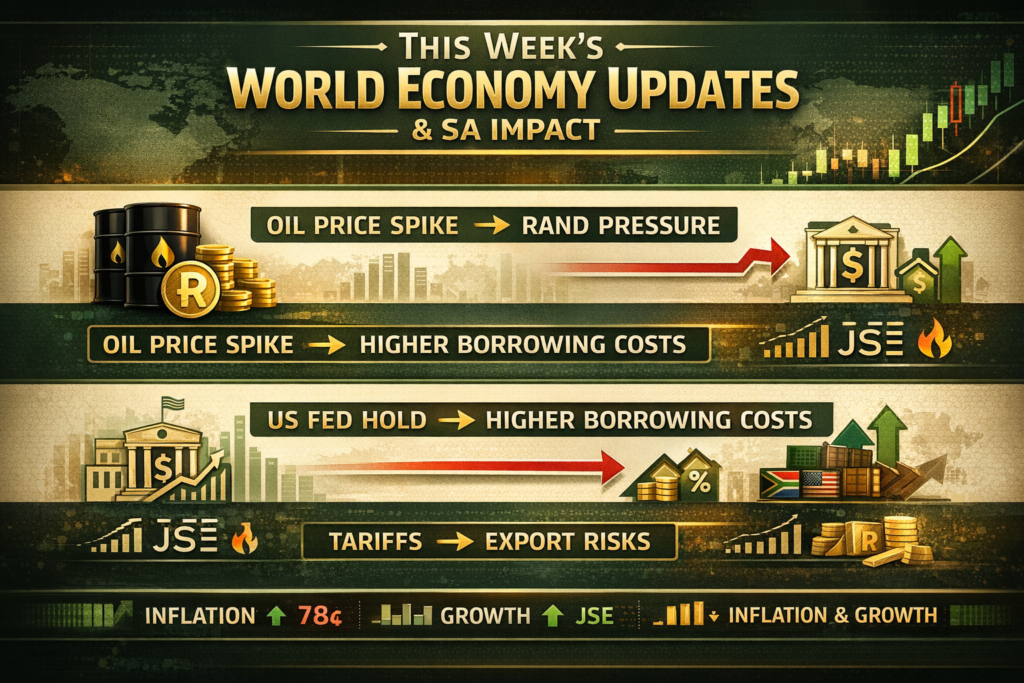
Another pivotal World Economy Update is the Federal Reserve’s decision to hold interest rates steady. This cautious stance, amid sticky US inflation and geopolitical risks, limits the scope for aggressive global rate cuts. For South Africa, it means the SARB’s Monetary Policy Committee (meeting this week) is likely to leave the repo rate at 6.75%, despite benign local CPI data.
Higher-for-longer global rates strengthen the US dollar, putting pressure on emerging-market currencies like the rand. This World Economy Update translates into costlier imports, elevated debt-servicing costs for government and corporates, and tighter financial conditions across the board.
Trump Tariffs and Trade Tensions – Ongoing World Economy Updates Affecting SA Exports
US tariff policies remain a recurring theme in this week’s World Economy Updates. With average effective US tariffs now significantly higher and Section 301 investigations expanding to include South Africa, exporters in automotive, steel, aluminium and agriculture face renewed uncertainty.
South Africa sends billions in goods to the US annually. Any escalation could shave growth points off key sectors and weaken the rand further. These trade-related World Economy Updates highlight how decisions made in Washington directly shape Sandton boardrooms and factory floors in the Eastern Cape and Gauteng.
Rand Volatility, JSE Performance and Local Market Reactions to World Economy Updates
This week’s World Economy Updates have already triggered visible movements:
- The rand has swung on news of Middle East de-escalation signals or renewed tensions.
- South African government bonds saw yields fluctuate as investors moved into or out of risk assets.
- The JSE experienced risk-off selling during global flight-to-safety moments.
Gold, a traditional safe haven and major SA export, has seen price spikes, offering some offset for mining companies. Yet overall, these World Economy Updates underscore South Africa’s vulnerability to external shocks despite domestic progress on infrastructure reforms and inflation control.
How Live Prediction Markets Help You Navigate World Economy Updates
In a world of fast-moving World Economy Updates, traditional news lags behind market sentiment. That’s where prediction markets shine. On Polymarket.co.za, South Africans can trade real-money contracts on outcomes such as:
- Oil price ranges in the coming months
- Likelihood of SARB rate cuts or holds
- US Fed policy paths
- Broader global recession probabilities or tariff escalations
These markets aggregate collective wisdom from thousands of participants with skin in the game, often proving more accurate than polls or analyst forecasts. By monitoring live odds on Polymarket.co.za, you gain an early warning system for how World Economy Updates will impact the rand, inflation and your portfolio.
Whether you’re hedging business exposure to fuel costs, positioning for currency moves, or simply seeking alpha from global events, prediction markets turn uncertainty into opportunity.
Broader Implications for South African Investors and Businesses
The cumulative effect of this week’s World Economy Updates paints a mixed picture. Positive domestic signals — moderating inflation, slight GDP improvement and reform momentum — are tempered by global headwinds. Middle East risks, US policy rigidity and trade frictions could slow South Africa’s projected 1.2–1.3% growth in 2026.
For investors, this environment demands agility. Diversifying into commodities that benefit from global tensions (like gold and platinum), monitoring currency hedges, and staying informed via live prediction markets are prudent strategies.
Businesses, especially exporters and importers, must stress-test scenarios based on the latest World Economy Updates — from higher input costs to potential loss of preferential market access.
Stay Ahead with Polymarket.co.za – Your Gateway to Trading World Economy Updates
South Africa no longer has to react passively to distant global events. Polymarket.co.za brings the world’s leading prediction platform directly to you, with rand-friendly deposits, easy withdrawals and markets tailored to events that matter most to SA.
Track probabilities on oil shocks, interest rate paths, tariff outcomes and more — all updated in real time as World Economy Updates unfold.
Don’t just watch the World Economy Updates — trade them with confidence.
Join thousands of informed South African traders who use Polymarket to stay ahead of global volatility and turn World Economy Updates into actionable opportunities for their portfolios and businesses.